Best Web Development Technologies for Business Websites in 2026
Best Web Development Technologies for Business Websites in 2026
Discover the best web development technologies for business websites in 2026, including React, Next.js, Node.js, TypeScript, WordPress, Laravel, and modern cloud tools.
Which Web Development Technology Is Best for a Business Website in 2026?
For most modern business websites in 2026, Next.js with React and TypeScript is one of the strongest choices for performance, scalability, SEO, and long-term development. However, the best technology depends on the website’s goals, content requirements, budget, integrations, and expected growth.
A simple company website may work better with WordPress, while a highly interactive platform, SaaS product, or custom business application may benefit from a React, Next.js, and Node.js stack.
The right technology is not simply the newest technology. It is the technology that delivers a fast, secure, accessible, search-friendly, maintainable, and conversion-focused website.
Top Web Development Technologies for Business Websites
1. React
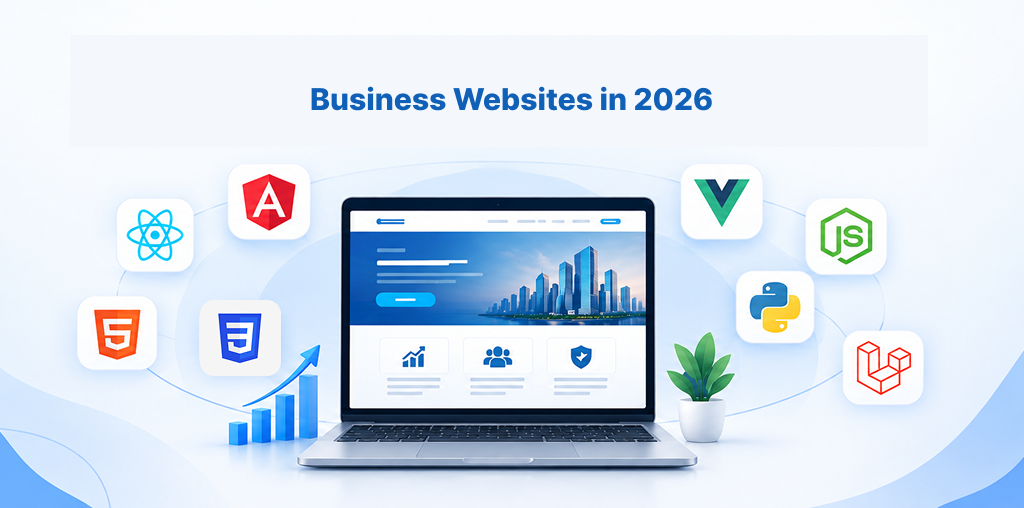
React remains a leading choice for creating interactive and component-based web interfaces. Its component architecture makes it easier for development teams to build reusable user-interface elements and maintain larger applications.
Best for:
Business portals, dashboards, custom web applications, interactive websites, and scalable frontends.
2. Next.js
Next.js is a React framework designed for full-stack web applications. It provides features for routing, rendering, data fetching, caching, performance optimization, and deployment.
For businesses prioritizing SEO, fast page delivery, modern user experiences, and scalability, Next.js is particularly attractive.
In 2026, Next.js 16.3 includes improvements around memory usage, builds, rendering, and instant navigation experiences, making the framework increasingly suitable for performance-focused websites.
3. TypeScript
TypeScript adds static typing to JavaScript, helping development teams identify certain errors earlier and maintain more predictable codebases.
For growing business websites and applications, TypeScript can improve code organization and developer productivity, especially when multiple developers work on the same project.
4. Node.js
Node.js is a popular JavaScript runtime for server-side development. It works especially well with React and Next.js ecosystems and can power APIs, authentication, integrations, dashboards, and custom business logic.
Best for: APIs, real-time applications, SaaS platforms, eCommerce functionality, and custom backend systems.
5. WordPress
WordPress remains a practical option for businesses that primarily need content publishing, service pages, blogs, landing pages, and manageable marketing websites.
It can be a good choice when the client wants a familiar content management system without developing a completely custom backend.
Best for: Corporate websites, blogs, service websites, local businesses, and content-driven websites.
6. PHP & Laravel
PHP remains valuable for businesses with existing PHP systems or projects that require a robust server-side framework. Laravel provides structured development patterns for custom applications, APIs, authentication, and database-driven platforms.
Best for: Custom portals, business software, APIs, booking systems, CRM-style applications, and PHP-based ecosystems.
7. Modern Databases
A successful website also needs the right database architecture.
PostgreSQL is a strong choice for structured, relational business data, while MySQL remains widely used for websites and business applications. MongoDB can be useful when flexible document-oriented data models make sense.
The database should be selected according to the application’s data structure rather than popularity alone.
Best Technology Stack by Business Requirement
| Business Need | Recommended Technology |
|---|---|
| Corporate Website | WordPress or Next.js |
| SEO-Focused Website | Next.js + React |
| Custom Web Application | React + Next.js + TypeScript |
| Business Dashboard | React + TypeScript |
| SaaS Platform | Next.js + Node.js + PostgreSQL |
| Content-Heavy Website | WordPress or Headless CMS + Next.js |
| eCommerce Platform | Next.js + suitable commerce platform |
| Custom API | Node.js or Laravel |
| Enterprise Application | TypeScript + Next.js + robust backend/database |
What Should Businesses Look For in 2026?
Technology should support business outcomes—not only development preferences.
Performance
A website should load efficiently across mobile and desktop devices. Image optimization, caching, efficient JavaScript, CDN delivery, and smart rendering strategies can improve the user experience.
SEO & Search Visibility
Modern development should support clean URLs, crawlable content, metadata, structured data where appropriate, semantic HTML, internal linking, and strong page performance.
AEO & AI Search
Business content should answer important questions directly and clearly. Well-structured headings, concise definitions, relevant entities, FAQs, expert information, and factual content can make pages easier for search systems and AI-powered interfaces to interpret.
Security
Authentication, access controls, dependency updates, secure APIs, HTTPS, input validation, and regular maintenance should be part of the development process.
Scalability
A website that works for 1,000 visitors should not become a technical problem when the business grows. The architecture should allow future integrations, more content, additional users, and new features.
Do & Don't for Choosing Web Technologies
| Do | Don’t |
| Choose technology around business goals | Choose only because it is trending |
| Prioritize speed and user experience | Overload pages with unnecessary scripts |
| Plan SEO from the beginning | Treat SEO as an afterthought |
| Use maintained and supported versions | Build production sites on outdated versions |
| Design for mobile users | Focus only on desktop screens |
| Plan security and scalability | Wait until problems appear |
| Keep the architecture maintainable | Over-engineer a simple website |
GEO, Semantic SEO & E-E-A-T for Business Websites
A modern business website needs more than keywords.
GEO (Generative Engine Optimization) focuses on making information clear, useful, trustworthy, and easy for AI-powered systems to understand and summarize.
Semantic SEO connects related concepts such as web development, frontend frameworks, backend technologies, databases, APIs, performance, security, accessibility, and search optimization rather than relying on repetitive keyword placement.
E-E-A-T can be strengthened by demonstrating real expertise, publishing accurate information, showing who created the content, maintaining transparent business information, and supporting important technical claims with reliable sources.
For development-related content, businesses should also keep technology recommendations updated because frameworks, security practices, and support policies change over time. For example, Next.js recommends production applications use supported Active or Maintenance LTS releases.
Expert Recommendation
Our recommendation: Start with the business requirements, not the framework.
For a new performance- and SEO-focused business website, Next.js + React + TypeScript is a strong modern combination. For a content-heavy marketing website where non-technical teams need simple editing, WordPress may be more practical. For custom business applications, select the backend and database according to data complexity, integrations, security, and expected scale.
The best stack is the one your business can operate, maintain, secure, and grow with.
From the Customer's Point of View
Customers do not care whether a website uses React, PHP, Laravel, or another framework.
They care about five things:
“Does it load quickly?”
“Can I easily find what I need?”
“Does it work properly on my phone?”
“Do I trust this business?”
“Can I contact or buy from them without friction?”
Technology should quietly support these outcomes instead of becoming the focus of the website.
Why Choosing the Right Web Development Stack Matters
The right technology can improve development efficiency, website performance, scalability, security, SEO readiness, and future maintenance.
At the same time, no technology automatically guarantees Google rankings, conversions, or business growth. Those results depend on the complete experience—including content quality, technical SEO, design, accessibility, performance, trust, and the value offered to visitors.


Frequently Asked Questions
1. What is the best web development technology for business websites in 2026?
For many modern business websites, Next.js with React and TypeScript is a strong choice because it supports scalable development, modern rendering, performance, and SEO-friendly architecture.
2. Is React good for business websites?
Yes. React is well suited for interactive websites, dashboards, portals, and custom web applications because its component-based approach supports reusable interfaces and scalable development.
3. Is Next.js better than React for a business website?
They are not direct alternatives. React is a UI library, while Next.js is a React framework that adds features for routing, rendering, data fetching, and full-stack development.
4. Is WordPress still good for business websites in 2026?
Yes. WordPress can be an effective option for content-focused business websites, blogs, service websites, and teams that need an accessible content management system.
5. Which technology is best for an SEO-friendly website?
There is no single technology that guarantees SEO success. A well-built Next.js or WordPress website can both support strong SEO when technical implementation, content, performance, accessibility, and site structure are handled properly.
6. Should a business website use TypeScript?
TypeScript can be especially useful for medium and large projects because it provides stronger type safety and can make complex codebases easier to maintain.
7. What backend technology is best for a custom website?
Node.js and Laravel are both strong options. The better choice depends on the team’s expertise, integrations, project complexity, hosting requirements, and long-term maintenance strategy.
8. Which database is best for business websites?
PostgreSQL, MySQL, and MongoDB can all be effective. The best database depends on the application’s data model, relationships, querying requirements, and scalability needs.
9. Does website technology affect Google rankings?
Technology can indirectly affect SEO through factors such as performance, accessibility, crawlability, rendering, and technical implementation. However, rankings depend on many factors and are not guaranteed by a particular framework.
10. How should a business choose its web development stack?
Start with business goals, user requirements, content needs, SEO requirements, integrations, budget, security, and expected growth. Then select the technologies that best support those requirements.
Build a Better Business Website with quitecoder.agency
Your website should do more than look professional—it should attract the right audience, communicate your value, build trust, and turn visitors into customers.
At quitecoder.agency, we focus on creating modern business websites with thoughtful technology choices, responsive design, performance, SEO-friendly architecture, and scalable development.
Ready to build a website designed for your business goals? Explore quitecoder.agency and take the next step toward a faster, smarter, and more effective web presence.
Final Takeaway
There is no universal “best” web development technology for every business. In 2026, Next.js, React, TypeScript, Node.js, WordPress, Laravel, and modern database technologies all have valuable roles.
Choose the stack based on what your customers need and what your business needs to achieve—not simply what is popular today.
Recent blog